In a narcissistic family, the mother is at the center of the system, while everyone else revolves around her like planets around the Sun […].
Over many years of working and talking with daughters who experienced maternal deprivation in childhood, I have come to see that we have excellent intuition, but it comes with a particular kind of deafness. Desperately searching for the love that was missing in childhood, the daughter decides to pay no attention to the warning lights coming on. We know. But we don’t listen.
Seeing themselves as stronger than they really are helps them suppress the pain.
quotes from the book
For me, 2024 is a time of putting in order (and acquiring) knowledge about complex trauma (repeated, prolonged trauma that happens to us in a relationship with another person — a parent, sibling, teacher, psychologist, coach, boss, etc.). Complex trauma grows into our lives — sometimes in a way we don’t notice — so that what is overwhelming, terrifying, and violating seems to us, on some level, natural, normal, healthy. It recalibrates not only our stress responses (as single-incident trauma does too, after all); it also affects our sense of who we are, what we are like, and what we are or are not entitled to. Today I want to tell you about one of this year’s reads that speak about how to recognize complex trauma and how to heal it.
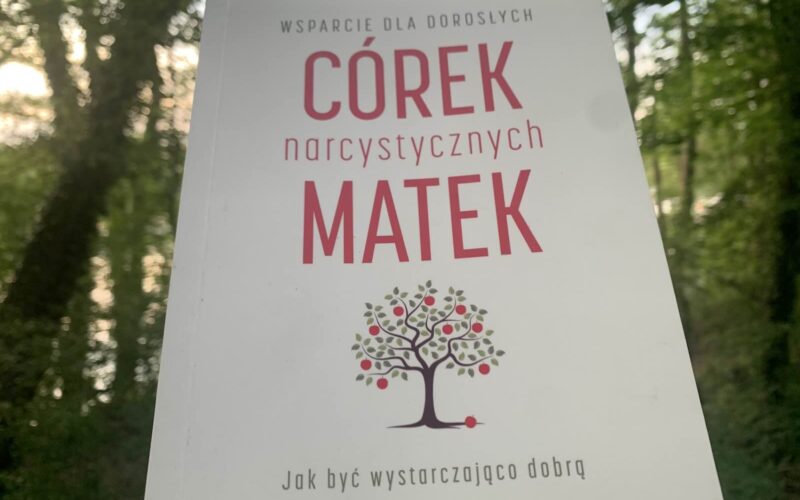
I learned about the book “Will I Ever Be Good Enough? Healing the Daughters of Narcissistic Mothers” from Meg Arroll, author of the book “Tiny Traumas” (I wrote to you about it here). When I had the chance to talk with the author a few weeks ago (I hope that conversation will see the light of day soon), I asked her about the books that had changed her life the most. One of the titles Meg Arroll named was precisely “Will I Ever Be Good Enough? Healing the Daughters of Narcissistic Mothers.” I ordered the book right away and started reading almost the moment I unwrapped it from the envelope. It was worth it! And although I rarely read anything with narcissism in the title, this book automatically joins the ranks of self-help books I recommend to my clients (and not only to women, nor only to people who were raised by a narcissistic parent).
It is, above all, a book about the fact that healing is not just an act of will. We heal by putting in intentional, sustained (the author writes: lifelong), and stubborn effort. Healing won’t happen without us (nor will separation from a parent — the criteria for it described in the book went straight to my heart). Healing is a gift to ourselves, to our children, and sometimes to our narcissistic parents as well. After all, we don’t have to remain in relational patterns that don’t serve us a moment longer. We have already suffered enough in our lives.
It is a book about the fact that naming what went wrong in our relationship with our parents does not automatically mean condemning our parents and cutting off contact with them. It is a book first and foremost about working on our own lives, not about holding anyone to account for what we did or did not receive. It is a book about going through grief, rebuilding our boundaries, about “inner mothering,” and — above all — about emotional, relational, and spiritual growth. It is also an excellent guide for those of us whose relationships don’t work out, who — to our surprise every time — find ourselves in a relationship with the same pathological dynamic, and for those who are recovering from (a quote from the book) “post-romantic stress disorder.”
Karyl McBride also writes in her book about the intergenerational impact of narcissistic traits, which, after all, we too inherit to some degree. I believe the chapters on parenting by the children of narcissistic parents (that is, us toward our own children) should be read by every parent without exception. For it sometimes happens that, despite wanting to break with the toxic model of upbringing we ourselves experienced, we land ourselves and our children in parenting without boundaries and with confused parent–child roles. And so we recreate the very thing we were so desperately running from.
I also like this book for its references to films and novels that portray narcissistic entanglement (photo below). I got a great deal out of its questionnaires, too, which do not oversimplify the complexity of human experiences and traits, but rather open us up to greater insight in looking at our own lives.
It is a good, reliable book that wakes us up to life and doesn’t let us slip into the role of victim. I highly recommend it to you <3.
Sabina