

I deeply believe that in trauma therapy we need both a clear philosophy guiding our work and a variety of methods that allow us to support a person in the way that suits them best. The most important sentence I heard at the TF-CBT training wasn’t about techniques or research at all; it was about honesty in how we use methods: “More important than whether a given method is effective is whether it is effective for the particular person you are working with right now.”
The training in TF-CBT, a method of working with trauma (that is, trauma-focused cognitive behavioral therapy), brought me several new pointers on how to support people in meeting their traumatic memories (I’ve listed them below).
TF-CBT is a hybrid method. It combines, among other things, a behavioral approach, family therapy, a humanistic approach, and of course cognitive work. It has its key components that should appear in the therapy, but it doesn’t impose a rigid form for implementing them. It’s a flexible method, focused more on the capacities, experiences, and needs of the person you’re working with, and less on conducting therapy step by step simply because that’s how it’s supposed to be done.
Here are a few of my notes from the training:
- The trauma narrative doesn’t have to unfold in a linear sequence (from beginning to end). The person can choose which moment of the story they want to focus on at a given time/in a given session. It is worth watching closely during sessions, though, which elements of the story are most strongly avoided (persistent avoidance reinforces the symptoms of PTSD or cPTSD).
- The “material” of the trauma narrative can vary: speaking, writing (the therapist can also write the story down — with children, in fact, it is most often the therapist who does this), drawing, working with therapeutic figurines, collage (my mind also goes straight to using therapeutic cards here). The person can also write a song, a poem, a script.
- The story of a traumatic memory should include elements of life before and after the trauma. The suggested sequence (chapters) of the trauma narrative is: 1. a story about me (who I am, where I live, how old I am, etc.) 2. the time before the trauma/the relationship with the perpetrator before the trauma 3. the moment/period of the trauma 4. what happened in my life after the trauma 5. my hopes/what this taught me (this is of course only an option; this element won’t always appear)/my future. You can also ask the person for a title for the whole story (something that will tie all the chapters together). Reflecting on the title, on the chapters, and on our thoughts and emotions about the trauma all train our psyche in gentler encounters with our most difficult memories.
- With cumulative/complex trauma, there is no need to tell everything that happened. What matters is that the story cover the most difficult event/the ones the person most avoids talking about.
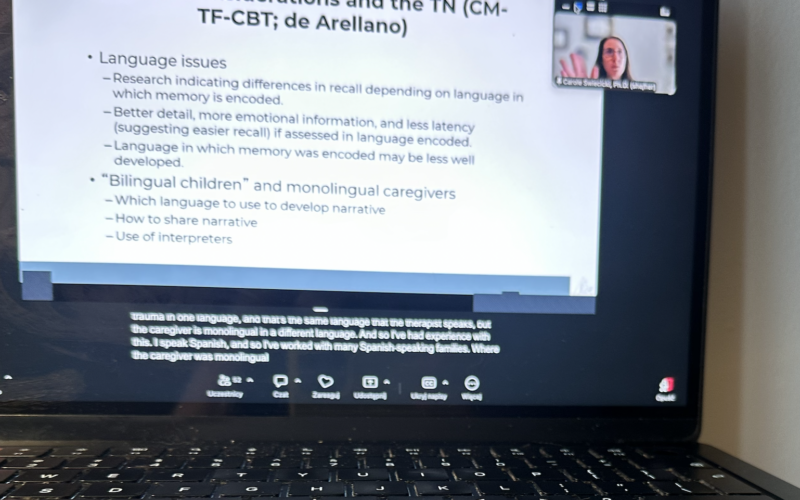
- Ideally, the trauma narrative can be voiced in the language the person was using when the trauma occurred. This is especially important for people with refugee/immigrant experience and for bilingual people.
- The trauma narrative allows the therapist to pick up on beliefs about the trauma that may be blocking a person’s resilience/healing. It’s important to let these thoughts be voiced, but also to look together with the client at what happens when we believe everything we think.
- An important question for the end of therapy: “What would you say to the you who was just starting therapy?”
- The TF-CBT method doesn’t always work (which, for that matter, is true of absolutely every method of treating PTSD and cPTSD). If a trauma occurred but the person doesn’t remember it (e.g., in the case of early childhood trauma or early medical trauma), TF-CBT is not the appropriate method.
Phew, that was an intense training (which is in fact still going on, as it now moves from the training format into the consultation format).
If this approach has caught your interest, I recommend reading this book: https://wuj.pl/ksiazka/terapia-traumy-i-traumatycznej-zaloby-u-dzieci-i-mlodziezy-wydanie-drugie .
Wishing you all the best!
Sabina