




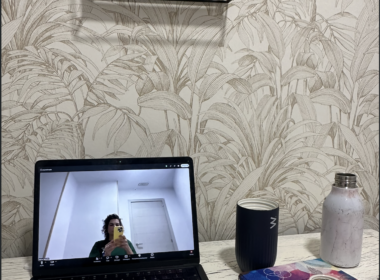


What an enormous privilege it is to be able to learn, and to learn from teachers like THESE.
Today I started training in the Brainspotting method with the wonderful Monika Gos. Brainspotting works with trauma at the subcortical level, reaching the deepest parts of our brain. It is extraordinarily gentle yet intense work, in which healing happens in the space of letting go of the mind’s control and allowing the client’s nervous system to do, on its own, what is needed to lead them out of post-traumatic stuckness.
A few important thoughts from the first day of the training (do keep in mind, though, that I am only just learning Brainspotting and am not an expert in it; I am simply sharing with you something that holds extraordinary therapeutic potential for me):
– The direction in which we look affects the emotional state we land in (how we feel and what we sense).
– The retina and the optic nerve are connected to the midbrain, and that is where our traumatic experiences are recorded.
– Important: “When we want lasting effects from psychotherapy, we need to engage the midbrain” (Jaak Panksepp).
– In trauma therapy, what matters is not only what the client says, but also how and when, in the course of that story (or silence), their eyes go still, twitch, or close, whether the client furrows their brow, swallows, moves a foot, etc. All these reflexive reactions may point to a traumatic experience encoded in subcortical memory.
– The position of our eyes is linked to the traumatic memory and carries with it the physiological consequences connected with that memory.
– Brainspotting is a physiological approach that produces therapeutic/psychological effects.
– The processing that takes place in the subcortical region is very fast. It does not have to be comprehensible to the neocortex (to our mind).
– In trauma therapy it is important not to get in the client’s way while their nervous system is integrating fragmented experiences.
– Brainspotting is not just a technique for working with the eyes (though I already know, too, that it is not only about the eyes); it works best when integrated into an attuned, resonant, co-regulating relationship between client and therapist.
Days 2 and 3 of the training are still ahead of me. I’ll write to you more about this training.
Sabina
PS In the photo you can see a pointer, an important prop in Brainspotting therapy.


