

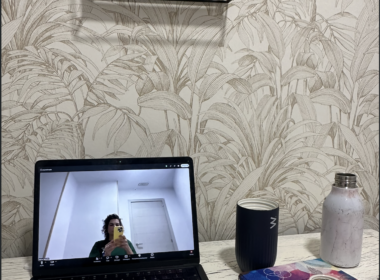


Orienting is sometimes confused with mindfulness. It is, however, a much broader and much more fundamental process. We orient constantly (even when we sleep, though of course to a lesser degree than when we are “awake”). Our nervous system is ceaselessly checking where we are, whether a given situation and moment is safe for us, and how much what is happening now reminds us of moments from the past. We orient with all our senses, with our exteroception, but also with the sense of inner attention — interoception. Without constant orienting, there can be no regulation, no returning to balance after moments of mobilization (the nervous system may not notice that the threat, or the need to take action, has passed). Nor is it possible to mobilize in a way that fits the situation. When we are not oriented, we may strain excessively, or fail to respond at all where we should respond.
Orienting can be woven into any kind of psychotherapy. Even if, as a therapist, you work at the level of beliefs, nothing stands in the way of adding to your cognitive work elements that support the client’s nervous system in being in the session in the here and now. You can ask the client to notice what is catching their attention right now, where their gaze is going, what they notice in the therapy room today that they hadn’t noticed before. It is also important to come back with them to (re)orienting after every significant therapeutic moment — when something very difficult emerges during the session, when the client makes an important cognitive reframe, when some piece of suffering recedes into the past. It is worth asking then: “And what is catching your attention now?”, “what are you noticing that’s new?”, “what is it like for you to be here with me in this session?” When something transformative happens during a session, the nervous system begins to perceive reality more broadly and more accurately. A widening of the spectrum of orienting is one of the litmus tests of how effective our therapeutic interventions are.
You can also bring orienting into your sessions, into your life, as a psychotherapy client (or entirely apart from psychotherapy). Pausing before the session begins, checking where your mind and your attention are (and not only where your body is), what is absorbing you and how you can widen your narrowed attention — this is something you can regularly weave into your time in session. You can also reorient every time you enter a new space or a new activity, or come into contact with new people. Novelty provokes turbulence in the nervous system. Notice it and orient to what is around you. Take in your surroundings, hear the sounds, notice the smells, the temperature, the textures. Orient, too, to what is happening in your body in moments of transition. Let the turbulence inside you settle, and bring your attention back to the here and now.
Trauma, stress, and overwhelm affect the way we orient. Some things in our environment we see excessively; we track them almost obsessively and focus only on them (e.g., on someone’s facial expression, on someone entering our personal space, or on signals that we are being abandoned). But an overwhelmed nervous system also misses a great deal (where there is an excess, there must, after all, be some deficit). Our well-being depends very heavily on the quality of our orientation and on seeing reality more as it is, and less as the trauma/stress we experienced earlier has sculpted our perception of it.
When we are oriented to what is happening around us, our awareness takes on a different consistency. We are more immersed in the present, and less in the frames imposed on our perception by our past. We can keep our attention with our inner and our outer world, with ourselves and with others (the latter is especially important when we are therapists). Being oriented (and constantly reorienting) means that fewer things disturb us. We are closer to ourselves and to our experience. We allow our attention to notice change, and we don’t get stuck in a loop of negative emotions, sensations, and thoughts.
At a training with Imke Hansen I read that the triangle of our self-regulation consists precisely of orientation + movement + connection (the sense of being in safe, attuned contact with another person). That is the triangle I wish for us today and every day.
Sabina
P.S. You can also read a good deal about orienting in my book “Return to the Body,” published in 2025 by Wydawnictwo Uniwersytetu Jagiellońskiego. A tiny excerpt from it is below.

P.P.S. If you are a psychotherapist who wants to deepen your knowledge of complex trauma, I invite you to my course starting this fall — “Relationship. Integration. Presence. A Complex Trauma Therapy Course. Edition 2”.