



(Most of my pieces take me a very long time to write; this one came together in literally an hour. But I really wanted, quite spontaneously, to share these thoughts with you.)
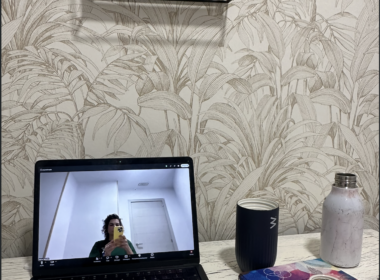
It’s high noon (today), and I’m sitting in an armchair with a view of Poznań’s old townhouses. My own psychotherapy session is underway.
“I’m discovering that I have to invite more colors, flavors, scents into my life… No, not that I have to… I WANT to, I want to invite more colors, flavors into my life…” I say to my therapist.
“Let’s pause here for a moment,” I hear her say. “Why did you actually correct yourself? What’s wrong with the fact that you HAVE TO?”
“Having to do something is compulsion, and wanting to is a choice,” I reply.
“And what if you, Sabina — with that temperament of yours, that passion — really do ‘HAVE TO,’ and not ‘WANT TO’?”
Come to think of it — it dawns on me in that very moment — what is wrong with “I have to”? And maybe I really do “have to,” rather than “want to”  .
For the rest of the day I smile (if a little grimly) at the idea that some concept should get to trim my own temperament. I think for a long time about this psychological self-censorship of mine. About hypercorrectness. And the wish to be the perfect psychologist. And suddenly it hits me that I actually have no idea how to do hypercorrectness. And I probably never really did.
I have been learning psychology for exactly 22 years. Ever since I started studying it, I have been devouring incredible numbers of books. I have dozens of conferences and trainings under my belt. I have put in hundreds (maybe thousands?) of hours sitting at universities, in clinics, at internships, in supervision and peer supervision. And yet all of that put together has not given me complete professional peace of mind (in fact, it has deepened my unease).
Over these 22 years I have lived through some diagnoses being consigned to the scrap heap, entirely new ones appearing, and existing ones migrating across various categories of psychopathology (just trace the trajectories of the OCD or PTSD diagnoses, or the inconsistent fate of the cPTSD diagnosis). I have seen pop-psychology labels used in the therapy room which — although they never gained scientific status — gave many people a sense of where they belonged in the world (with the HSP concept, so controversial lately, leading the way). I have noted an adoration of clinical diagnoses that repeatedly (and for many years) pulled people away from the essence of their suffering (and, all in all, did more harm than good). I learned from, was supervised by, and was in therapy with people who stayed close to scientifically validated methods, and people who openly cut themselves off from science (yet I always chose the person and their wisdom, not the titles next to their name). For years I immersed myself in a therapeutic approach with strong scientific validation that turned out “professionals” completely unprepared to fulfill their professional role. My first school of psychotherapy was considered only moderately scientific in Poland, yet one of the most scientific in Germany (could science be more regional than I thought?). And at present I am learning a method that is described at some conferences as the most scientifically rigorous, and at entirely different ones as an oddity (while in my practice (and in my life) I owe that method a great deal).
So — after 22 years of accumulating question marks, contradictions, paradoxes, and professional goodbyes — I am very incorrect in my work. I want therapy to work. What I don’t want is for it to build a monument to some particular approach or to statistical significance (or meta-analyses). What I am for is integrating scientific knowledge with personal grounding. For left- and right-brained work (although the notion of right- and left-brainedness has, of course, plenty of opponents by now too). For numbers and heart. For rationality and intuition. Together. In close cooperation.
The best thing a therapist can do for themselves (and their clients) is — in my view — continuous development and broadening of knowledge, good personal therapy (a step so often skipped on the way to becoming a psychotherapist), a trusted supervisor, and mentoring from almost the first day of work. Because science-based methods can take a grounded, self-aware therapist a long way in their work. But scientifically proven methods alone, placed in the hands of a therapist who is cut off from themselves (and from others), can at best do… nothing.
So I’m rooting for all your incorrect “I have to”s, for your own paths, and for your “unscientific” discoveries too. Look for your own ground, your own calm amid the professional unease, and don’t let theories cut away any part of who you are.