Today’s post is about many different points of existential intersection. And about how, at a certain moment, they all come together into one important moment, one remarkable conversation, a text that has gone to print and now has a chance, in print, to sow a few life-giving reflections in other people, to create a few new intersections.
 The very first intersection is the one with Asia Krajewska. We studied together in an amazing inter-university degree program, at the Akademia “Artes Liberales.” Asia was in the Akademia’s second cohort, I was in the first, and what bonded us most was the Akademia’s final session, a shared train journey, and a night lost to never-ending conversations. Since then we have done many things together and gone through more than one crisis side by side. You can find Asia here, among other places: Dialogi i zmysły .
With Maria Sitarska, the point of intersection appeared on Cicha Street, where we had the first psychotherapy practices of our lives. After that, every subsequent practice — and every important moment in life, too — was shared with Maria. And together we also co-create the website opsychologii.pl . Maria is my sister in spirit, and many thoughts, and even dreams, happen to us in parallel. You can find Maria here: Maria Sitarska – psychologia i psychoterapia and Fundacja Trzy Bramy. And of course here: opsychologii.pl.
With Maciej Duda, the most important intersection is the one in Sokołowsko, where — together with Asia, but also with our shared thesis advisor (shared by all three of us) — we followed in the footsteps of the book “Bitter, Bitter” and of Joanna Bator. It is one of the more important memories of my life. You can find Maciej here: Maciej Duda and of course here: Czas Kultury .
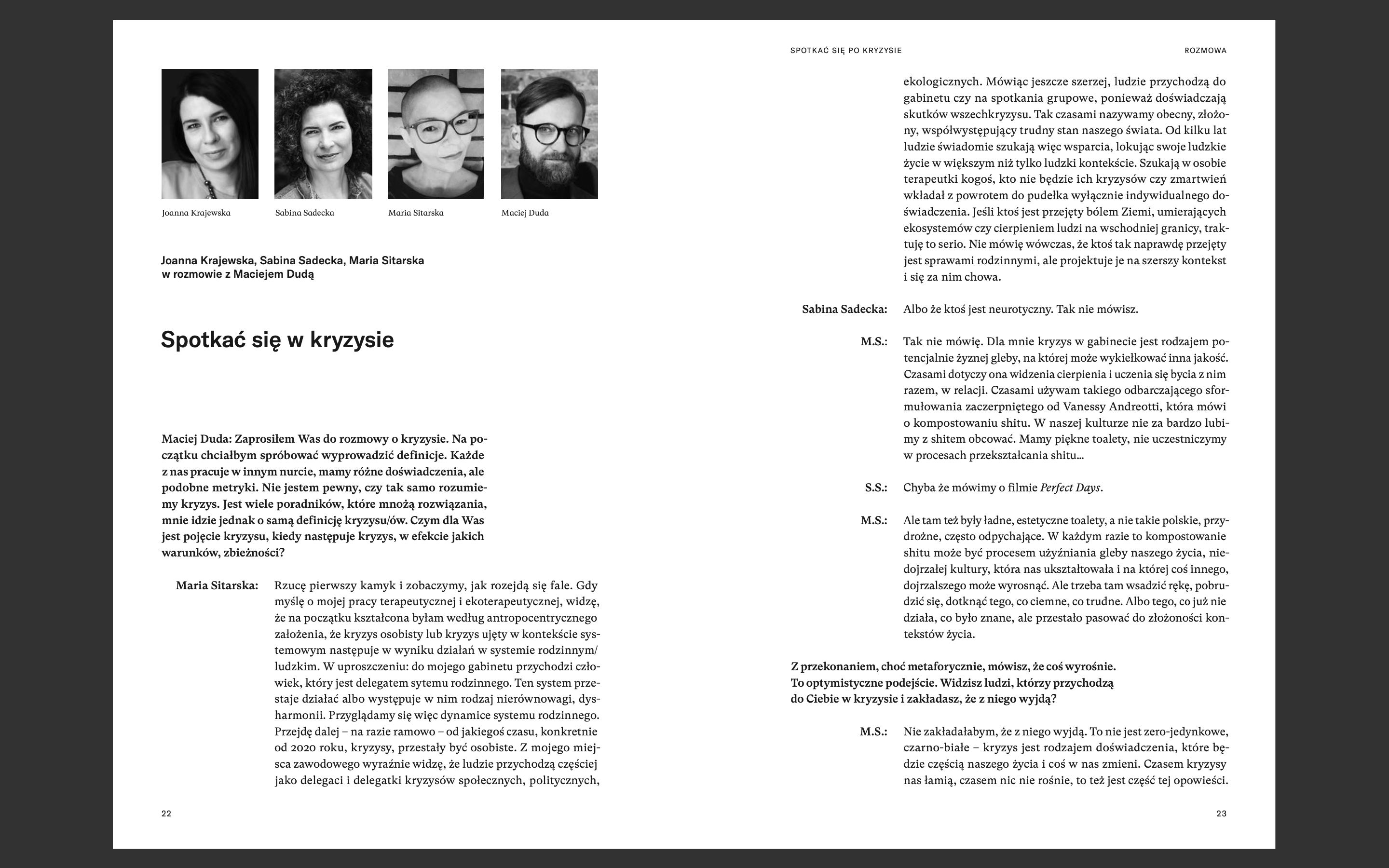
And so the four of us, buzzing with intersections, sat down to a conversation about crisis for the anniversary issue of Czas Kultury. Three of us are psychotherapists, all four work in the field of psychology, and all of us hold degrees in Polish studies. And those aren’t our only professional intersections, either.
During that meeting we talked about crisis. About individual crisis, and about why speaking only of the individual in crisis (and not of the system in crisis) is far from enough. About finding space in the existential tightness in which crisis imprisons us. About crises written into our DNA and about crises that persist. About “warm” and “cold” data. About the midlife crisis (but of course!). About dark ecology. And about books that matter in the context of crisis.
It’s a vibrant, flowing conversation, cut off far too soon  . I invite you to read it.