






TRAUMA AND THE NUMBNESS THAT IS SO HARD TO COME BACK FROM
Trauma arises when our nervous system is unable to contain the upheaval stirred up in it by a terrifying or overwhelming event, situation, or relationship (for example, a car accident, arriving late for a final high school exam, or experiencing abuse in a relationship). To keep from going crazy in such an extreme situation, we urgently need something that will cut us off from the extreme feelings and overwhelming reactions of our body. Our nervous system then reaches for a mechanism that is not very subtle but very effective: numbing us to our inner sensations. And this is exactly where the paradox of trauma comes from: even though it stirs up extreme emotions in us, emotions the mind cannot grasp, we feel those emotions less and less. It is as if an overpowering hurricane were raging inside the stone walls of our psyche. The stone walls keep the hurricane locked inside, but they also give the emotions seething within us no way out.
There would be nothing wrong with this strategy of numbing us to feeling if it were followed by a period in which we slowly got used to our post-traumatic emotions. But we live in a culture that is scared to death of strong, uncontrolled sensations. You will also look in vain there for guidance on how to naturally come back to yourself after traumatic experiences. No one teaches us how to feel again what our nervous system, in its survival reflex, so effectively locked away from us. And so a strategy of cutting us off from difficult emotions that was meant to work in the short term becomes a way of avoiding the world of inner experience over the long term. Meanwhile, the emotions we have been out of touch with for so long come to feel more and more threatening. In order not to feel them, we need to put more and more energy into the mechanisms of numbing.
We can numb ourselves in different ways (I will be presenting them one by one on this blog). In this article I look at how being in constant motion (constant busyness, hurrying, bodily arousal) allows us to effectively cut ourselves off from difficult — post-traumatic — feelings, and what consequences this may have for us.
MOVING AND DOING SO AS NOT TO FEEL
One of the more common and (most often) unconscious strategies for coping with trauma by cutting off from feeling is being in constant motion and in arousal that never dies down. Sometimes this incessant restlessness takes a purely physical form — we keep jiggling our legs, snapping our fingers, touching some part of our body, scratching, picking… In moments when we stop, anxiety, or even panic, suddenly catches up with us. We stay constantly alert and keyed up, because trauma has taught our nervous system all too well that catching our breath, relaxing, and letting go of the constant scanning of our surroundings do not always pay off. For our nervous system, stopping is associated with being exposed to yet another trauma or — just as terrifying — with a flood of emotions we have been out of touch with for so long.
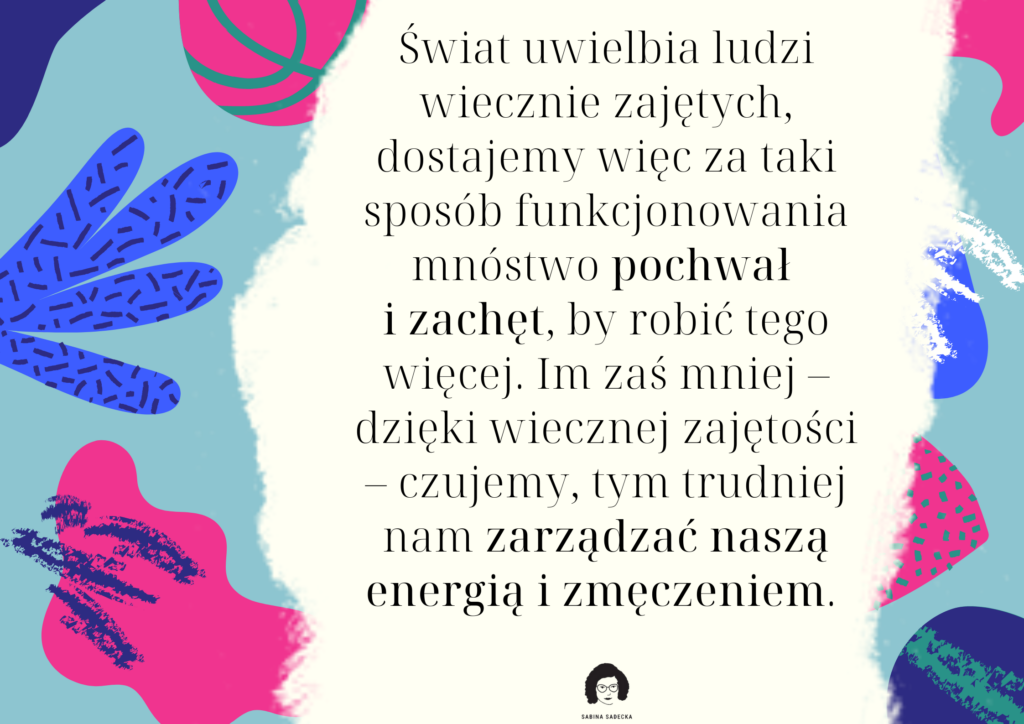
Our restlessness as protection against feeling and experiencing can also extend to the way we structure periods of time — a day, a week, a month, whole years… We fill every minute of our day with activities, our workdays and our days off (if we allow ourselves any rest at all), entire months and years; we plan our whole life in minute detail. Yet the strategy of being constantly busy is rarely associated with trauma, because it tends to bring to mind our agency, productivity, and psychological resilience. The world loves people who are always busy, so for functioning this way we get plenty of praise and encouragement to do even more of it. And the less we feel — thanks to being perpetually busy — the harder it is for us to manage our energy and our fatigue. That is why cutting off from feeling through constant doing is a very effective recipe for burnout, exhaustion, depression, and other states of mind that immobilize us.
DOING AS A PROSTHESIS FOR A SENSE OF SAFETY
Nonstop doing can help us do a great job of masking (from ourselves) our lack of a sense of safety. And that is exactly what trauma takes from us most effectively: a sense of trust in ourselves and in others and, linked to it, the predictability of the world around us (the inner world, too!). After all, the essence of trauma is our defenselessness and the fact that our capacity to trust others, and to trust the world in general, has been strained. Being unable to feel safe also means being unable to anchor ourselves in the world we live in. Where we cannot meet this need, we develop prostheses for it. Constant busyness is one of them. Many of us relax only on a nonstop hamster wheel, looking at the clear structure of our calendar, new tasks, tempting projects. All kinds of activities and work let us turn our attention away from what keeps trying to break through to us — despair, sadness, terror, anger…
HURRYING WITHOUT INTENTION
Sometimes the post-traumatic habit of being in constant motion also takes the form of never-ending haste. Even when our calendar is almost empty, we still put off certain tasks endlessly, only to frantically make up for the hours and minutes we have robbed ourselves of (yes, procrastination can have its roots in past trauma). Sometimes we do everything fast, even when circumstances don’t require it of us: we breathe fast (or hold our breath), we chew our food fast, we talk fast, we walk fast, and we have sex fast. Just as if some voice inside our head never stopped saying “quick! quick! even quicker!” The job of this chase is to tightly fill the gaps between our awareness and our untamed feelings.
A MIND IN CONSTANT ACTION
There is yet another form of post-traumatic restlessness — the restlessness of our thoughts, our mind running in its highest gear. Our nervous system sometimes allows itself to swap a very troublesome symptom for one that is also troublesome but more acceptable to us (remember that all along we are writing about mechanisms that most often operate outside our awareness, because they have become so automatic in our mental life). That is exactly what happens when we “cover up” our emotional suffering with a stream of thoughts. However unpleasant it may be for us to live with cruel thoughts (or simply with thoughts we cannot control), in the economy of inner suffering this is still something smaller than confronting the non-cognitive realm. So many of us lean heavily on thinking mode (in contextual therapies we speak of “problem-solving mode”) to screen off the inner turmoil. We dwell on things (or, really, we ruminate), we worry, we analyze, and above all we try to plan everything perfectly. Sometimes we also blame ourselves, others, the world. We use our thoughts in the worst possible way. But it is only thanks to them that we can have less contact with the realm of sensations (which, ever since the trauma, we have — consciously or unconsciously — been afraid of).
CLICKING INSTEAD OF FEELING
Another way in which being constantly busy can numb us to feeling is something I provisionally call “clicking our feelings away.” It has to do with our constant, never-ending, unrestrained use of technology to cope with whatever is trying to get out of our emotional space. After all, it is hard to feel anything when we play computer games a dozen or so hours a day; it is almost impossible to leave an empty space for emotions when we check social media every few minutes (seconds?!), and in the evening — the time when our bodies naturally tune in to themselves and their needs — we turn on a series and mindlessly devour several episodes. A flood of stimuli has a negative effect on our nervous system whether or not we have experienced trauma. But for people who have experienced trauma, being absorbed by this many stimuli cuts us off from ourselves even more effectively, and the negative consequences of the inner hurricane wreak even greater havoc in us.
DOING IS NOT BAD IN ITSELF

Finally: an important note. I want you to understand me correctly and not conclude that this article is directed against work and commitment. Work as such can be therapeutic, restoring the agency that trauma took away and allowing us to put down roots in the world around us. Part of many trauma therapies (and not only trauma therapies!) is often redirecting the client’s attention to how their activity (professional or otherwise) can be used to nurture the values that matter most to them. What this article is about, however, is toxic constant busyness whose function is to take us AWAY FROM pain rather than to move us TOWARD something our heart longs for. So before you start crossing more tasks off your planner, ask yourself: “Does what I am doing right now (and the way I am doing it) bring me closer to the life I want to live, or does it perhaps just allow me not to see something in myself?”
HOW CAN I TELL THAT I’M AVOIDING BY DOING?
Activity that protects us from feeling at any cost is often accompanied by a sense of pressure, panic, confusion. In this hamster-wheel doing of ours we may also feel completely alone, cut off from our resources, overtired. Values-directed activity, on the other hand (the opposite of activity whose aim is avoidance), even if intense and hard to control, lets us experience a feeling of deep satisfaction and connection with people and with the world around us.
Trauma therapy shows us alternatives to the frantic rushing around: slowing down, stopping, being curious about our inner world. It does so slowly, gently, and with respect for the fact that for a person who has lived with emotional numbness for years, it can be extremely hard to suddenly make contact with everything that has been hidden inside. It is a journey from constant frustration and a sense of not being enough to a life “without trying to carry five one-and-a-half-liter tasks in a five-liter bucket” (Rick Hanson). It is a journey toward ever greater integration, bringing what steers our behavior “from the back seat” up to the front rows of our awareness.
I’m rooting for your explorations, your slowing down, and your coming alive!
Sabina Sadecka, teacher of trauma therapy, Somatic Experiencing practitioner, creator of the podcast “Ładnie o traumie”.


