


After my first piece on Brainspotting many people asked me what it’s like to work with Brainspotting, whether I’m seeing results, and how the method works over time. Here are a few first observations.
First: I don’t work with Brainspotting alone, and I see the greatest value of my work in integrating several methods. The foundation is still cognitive work (with narrative) and behavioral work (with tender exposure to traumatic memories), Somatic Experiencing (multilayered work with trauma). I do think, though, that within this set Brainspotting is the approach that lets you deepen your knowledge of the client’s inner landscape, shows the limbic connections between memories (limbic meaning emotional and associative rather than rational and logical), and above all sets in motion blocked defensive responses, which you can then work with wonderfully using other methods.
Second: I see a huge change in the quality of my work since the Brainspotting workshop, in how grounded I am in session, in my presence as a therapist. Maybe it’s the effect of the several Brainspotting sessions I went through during the training; maybe it comes from understanding even better what the therapeutic relational frame is (which I heard about at the workshop and observed in practice many times). Whatever the origin of this change, though, I now work differently — more calmly and more precisely.
Third: Brainspotting has turned out to be useful in most of the processes I lead. There are people who speak of a breakthrough after Brainspotting sessions, there are those who simply experience something new and fresh, and finally, it also happens that some people don’t benefit from this work at all (a definite minority, but for me it’s still very important feedback about what does or doesn’t work for these people in therapy). In other words — Brainspotting has entered my practice with a bang and with many benefits, but I still have a lot of work ahead of me to integrate it into my sessions in a way that benefits clients as much as possible.
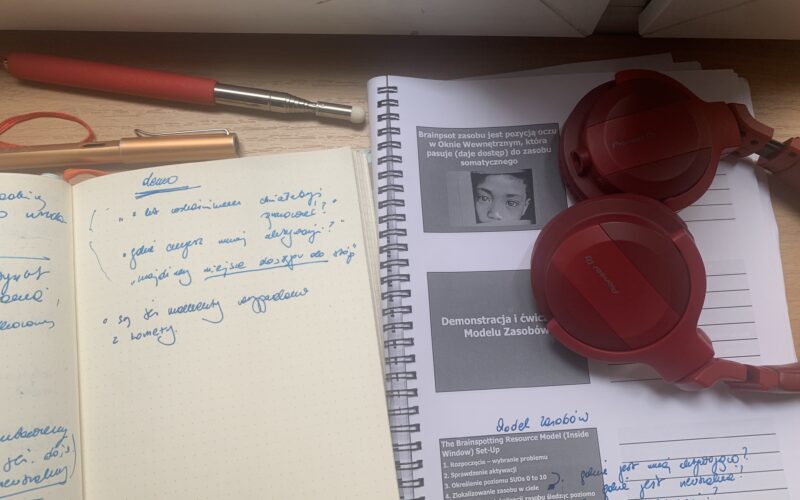
I’ll leave you now with a few of my previously unwritten notes from the Brainspotting workshop with the outstanding (truly outstanding!) teacher Monika Gos. Make use of the notes below, but I also strongly encourage you to learn from Monika!
1. Trauma jams our inner communication. In therapy, it’s important to get to know the inner coherence of the client’s nervous system. Therapy is meant to encourage our nervous system to start talking to itself.
2. Attunement to the client in therapy is just as important as setting healing in motion on the neurobiological level.
3. A therapist can attune to the client only by staying in a state of uncertainty (to know for sure means not being able to fully attune).
4. Contact with resources is also a way of reaching traumatic memories.
5. “How old are you in what you’re in right now?”, “Do you know what you’re looking at when you talk about this difficult thing?” (questions from the demonstration session).
6. Instead of “doing” something in therapy, strengthen your presence. “Presence is the vehicle of therapeutic change.”
7. The client doesn’t have to trust us right away. Let’s make room for that trust to be built (and allow for initial distrust — it, too, can be an expression of a survival strategy).
I’m rooting for you in your trauma work!
Sabina Sadecka