



The nervous system — the therapist’s as well as the client’s — has a great deal to tell us in the course of psychotherapy. It is an important assistant in our therapeutic moves, constantly hinting at whether we are heading toward vitality and integration in therapy, or wading with the client into their old strategies of dysregulation and numbness.
Here are a few important tips on how to read the language of the nervous system and how to make it a permanent part of our therapy sessions.
SLOW DOWN.
1. The vortices of our dysregulation feed on haste and thoughtlessness; in your therapy, let unhurriedness and curiosity take their place.
Don’t rush into the process of psychotherapy with your client. Before you begin the therapeutic conversation, let the nervous systems — yours and your client’s — settle at least a little (and make room for noticing what a colossal difference this makes in therapy). Begin therapy sessions slowly and in full contact with what is happening inside you and around you. Feel the presence of another nervous system beside you; recognize its melody and the melody the two of you share. Don’t hurry. Don’t speak. Postpone the client’s speaking. Check how it feels for them to be sitting here with you today, and whether, besides their body, their attention has arrived in the therapy room too. Let them orient in the 3 channels that matter for their well-being: perception (how they see the world outside), interoception (what is happening in their inner world), and neuroception (what is happening between you, and whether they feel safe with you and in the present situation). Use breathwork and body-oriented work (gentle movements that regulate the nervous system and changes in the position of their body) to ground the client a little more. Before the whirl of words and automatic reactions sweeps them off toward old coping mechanisms, let them — and the two of you — feel what the experience of stability in the body is like.
Repeat the process of orienting to the client’s outer and inner world after every significant moment in therapy. Respect the natural rhythm of balancing intense therapeutic work with slowing down and noticing change.
2. TRACK THE SIGNS OF OVERWHELM IN THE CLIENT’S NERVOUS SYSTEM.
Observe how much arousal the client’s nervous system has the capacity for, and notice the signals that this capacity is just running out. In therapy we usually work at the edge of overwhelm (since we want the client’s difficulties to show up during the session), but we try not to go beyond that edge.
So, together with the client, get to know the trajectories of their arousal in depth, and notice the moment when their emotional agitation turns into chaos or triggers rigidity/shutting down (I hope you know this distinction made by Daniel Siegel in his book “Mindsight”). Create as many therapeutic situations as possible in which the client is in a state of arousal and can at the same time observe it from within. If, however, the ability to observe oneself is unavailable at a given moment, you have most likely charged headlong into a state of overwhelm, from which you need to turn back without delay (in that situation, use the tips from point 1).
3. NOTICE THE SIGNS OF INTEGRATION IN THE CLIENT’S NERVOUS SYSTEM.
We don’t change because our emotional stirrings cease. We change because we are able to stay present even in the most difficult emotional storms. The important moments in therapy, the ones that speak of healing, are therefore those in which we see that in the very midst of sympathetic arousal (mobilization, pressure to do something, fight or flight), the client also finds parasympathetic energy (of calm, settledness, pausing) *.
So in therapy, look for stability in unstable moments, calm amid emotional turmoil, lightness in the heaviest problems, acceptance in place of desperate control. Notice the transitions from a state of hyperarousal or freeze toward greater fluidity, grace, and ease of movement. Notice the situations in which the client can modulate or change a once-learned, automatically arising reaction to a stressor. Practice with the client describing what their nervous system would like to do at a given moment (e.g., curl up the body, stop the story, pick a fight with someone) without following that impulse. Notice together with them that there are far more ways of responding than what their emotional pain is suggesting at that moment.
4. ALLOW THE UNFINISHED TO BE FINISHED.
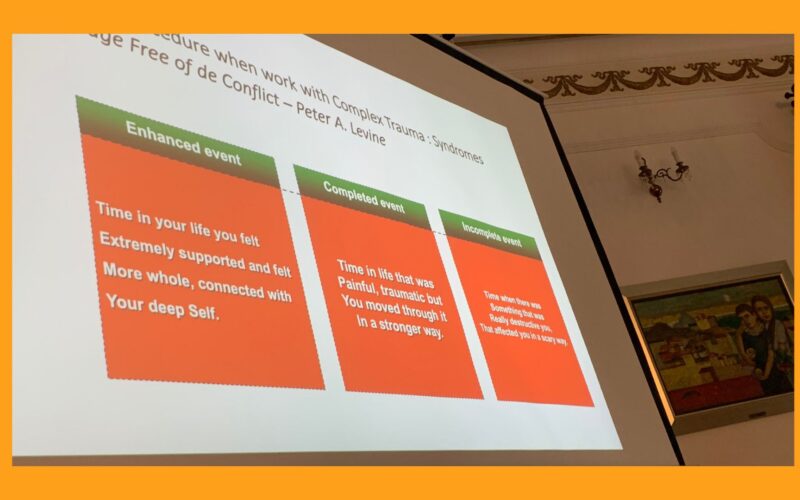
The nervous system carries within it our various unfinished responses to difficult situations . These may be words that once got stuck in our throat (“you don’t do things like that to a child!”), reflexes that could not be completed (being unable to escape from a burning car), or bodily reactions that someone blocked right in the middle of their course (stopping the body’s shaking after a traumatic event, e.g., by administering sedatives). Yet in order to heal and grow, we need to finish what was brutally blocked in us. Without that completion, we are doomed to endlessly repeat our unclosed reactions.
Track those behaviors of the client that are repetitive on the one hand, and on the other lead to nothing conclusive — they don’t bring the client to a solution to any problem, don’t deepen their awareness, don’t contribute to their existential maturing. These may be behaviors at the level of the body (blocked, incomplete gestures), emotions (a halted expression of, say, anger), thoughts (planning without follow-through, obsessions), or impulses (being unable, for years, to write a thesis). Look in them for links to reactions that could not be carried through to the end.
Let the client see where their nervous system got stuck and how faithfully it replicates an old, automated way of kindling emotional arousal and then inhibiting itself within it. Ask: “And if you could go further, one step forward, into what you once couldn’t do, what would that be?”, “What would have to happen for that disgust to disappear from your mouth?”, “How do you imagine your body would behave if, after the accident, it were allowed to recover in peace?”
Lead the client — slowly! — toward unblocking successive elements of the reaction, toward “finishing” them. Use imagination, therapeutic writing, body-oriented work, and art therapy for this (for this completion of the reaction to be truly healing, it needs to happen at the level of experience, not just at the level of intellect and thought).
5. ALWAYS ASK ABOUT INTENTIONS.
And finally, one more important tip. Work with the nervous system needs to take into account all the layers of its functioning: the level of bodily sensations, emotions, memories and images, impulses, but also — if we are to speak of full integration — the level of making meaning and seeking intention. In therapy we can, after all, track bodily sensations, name emotions, and examine blocked impulses endlessly. Without a clear intention, such work can go on forever (and lead not to deeper integration, but simply to greater awareness).
So always remember to ask a question that will allow the attention and energy of the client’s nervous system (and yours) to be put to good use: “What intention did you come here with today?”, “What would you like to change for you as a result of the work in this session?”, “What important thing are you coming here for?”
<3
Good luck with your therapeutic processes! And with your own processes of growth! May they bring much good to you and to the world. And a peaceful holiday, if you are celebrating.
Sabina
* I owe this observation to reading Marianne Bentzen’s book; I wrote a little about it here.