






One of the problems for people with PTS and PTSD is that fear persists long after the threat has passed, often forming associations with more and more stimuli in the environment.
Babette Rothschild, “The Body Remembers.” WUJ. Trans. R. Andruszko.
When tension is generated from within (from the muscles and viscera), a person is under strong pressure to locate the source of the threat in their surroundings. If that proves impossible, the belief arises that the threat exists, even though its source cannot be identified.”
Peter A. Levine, “In an Unspoken Voice,” Czarna Owca. Trans. P. Karpowicz
If you believe the universe is a place where everything collides with everything else, your own arms become a cradle in which you want to hold something that keeps you from losing your mind.
Gabe Habash, “Stephen Florida.” Wydawnictwo Poznańskie. Trans. J. Polak.
Our ability to function well rests to a huge extent on our flexibility: the flexibility of our muscles, of our emotional states, of our thoughts, and above all the flexibility of our reactions and behaviors. To maintain this flexibility, we need to keep checking how well the amount of energy we expend (mental and physical) matches the demands the world places on us. If we expend too little energy, we are in danger, because we may not be sufficiently prepared for what might happen to us. If we expend too much, we risk exhaustion (especially if the pattern of straining keeps repeating).
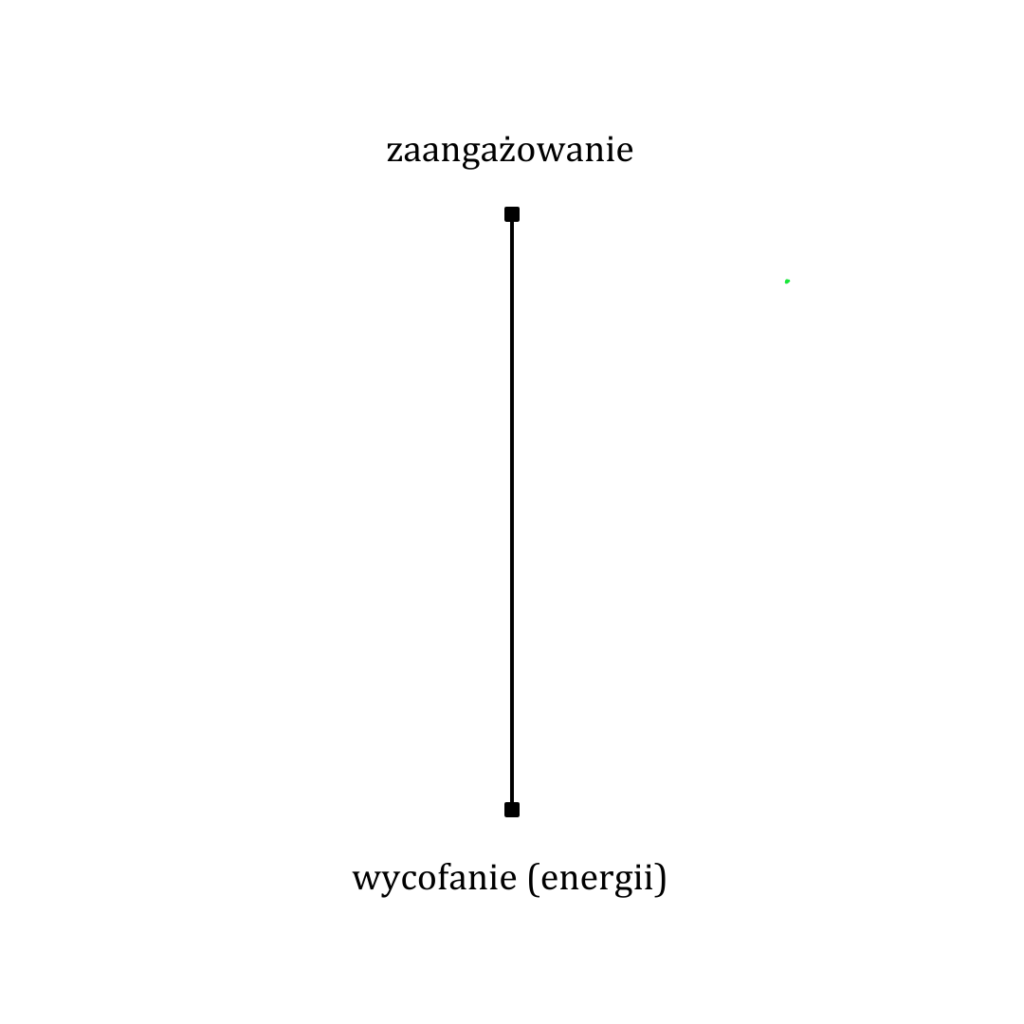
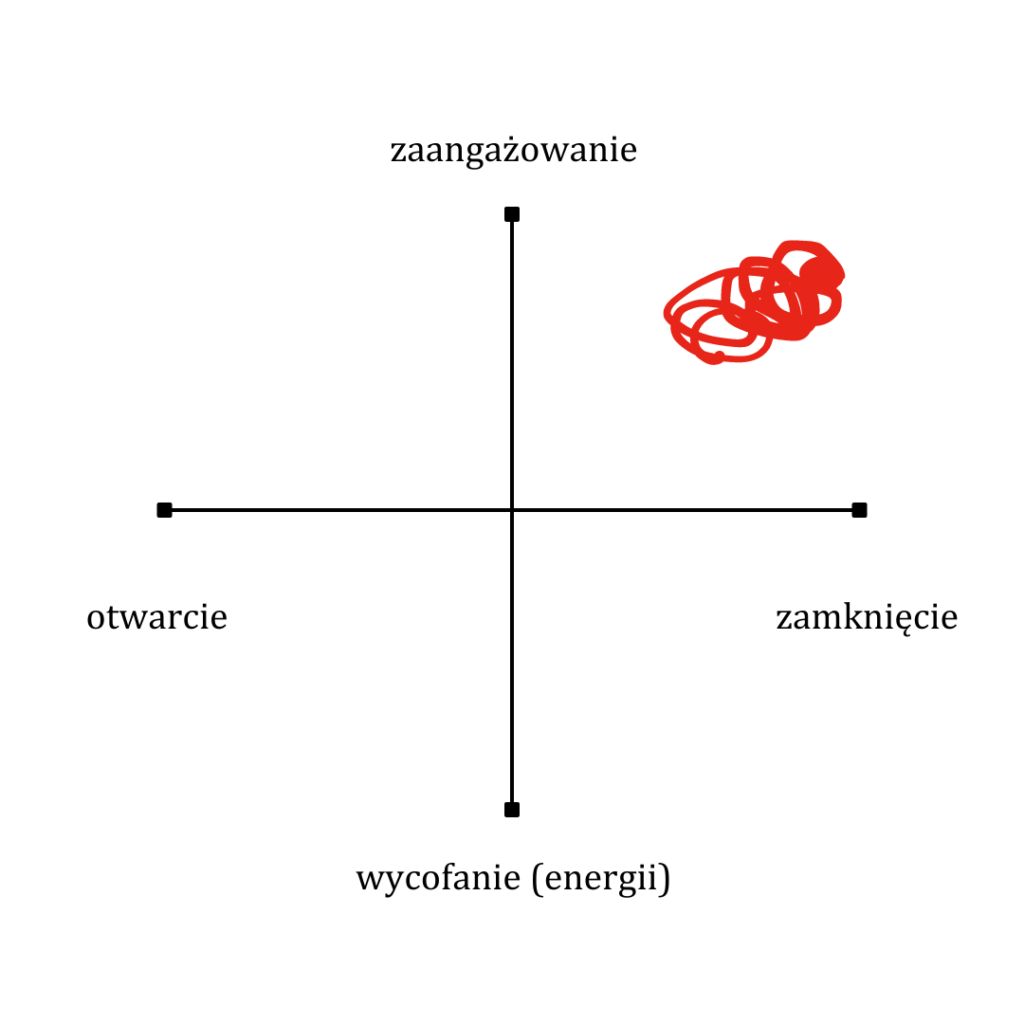
Mobilizing and withdrawing energy rhythmically, in alternation, and in a way that fits the situation is not, however, all that determines our flexibility. Its second dimension concerns consenting or not consenting to an experience — in other words: psychologically opening up or closing off to what is happening to us at a given moment. We can greet our various experiences (e.g., an unexpected pregnancy, stress before a public speech, the pain of getting a tattoo) with psychological spaciousness: accepting them, settling into them, being glad they are here or on their way. We can also react to what happens to us by closing off: resisting it, denying it, tensing up, cutting ourselves off, straining, hiding from it, and escaping from it into not feeling. Opening up to stimuli is not always the right response, and closing off to them is not always the wrong one. Years of upbringing, experience, and reflection allow us to learn when the stance toward an experience that serves us best is openness, and when it is slamming the door on it. For example: closing off to thoughts about how unprepared I am for my final exams while I am actually taking them may be a good strategy in the moment. Opening up to thoughts about how very unprepared I am for those exams a month before the retake, on the other hand, may be an excellent one.
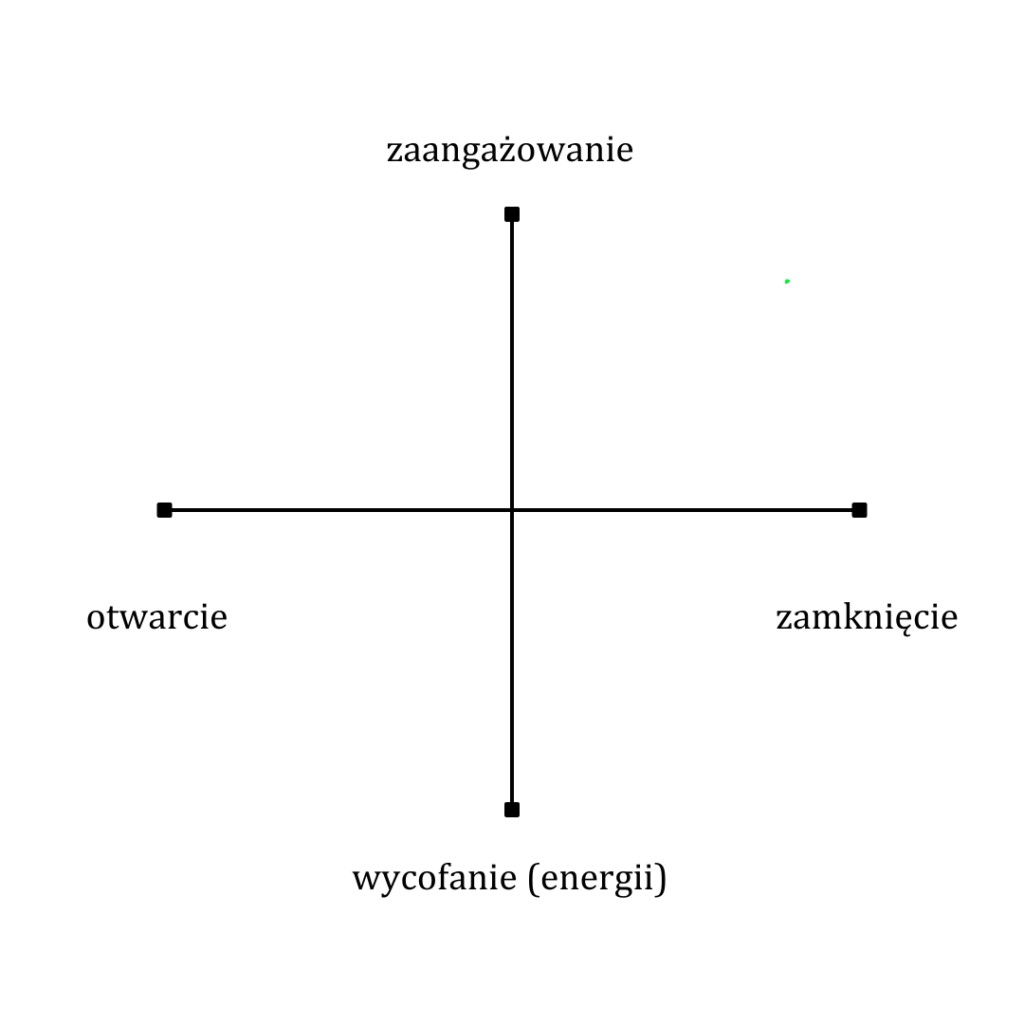
Our well-being will depend heavily on the combination, right for the given moment, of the two dimensions described above: expending vs. conserving energy, and closing off vs. opening up to experience. When I lose someone close to me, I can withdraw from activity (conserve energy) and at the same time open up to feeling grief, so as to appreciate as fully as possible the presence of that person, so important until now, in my life. When I run a marathon, I can expend more energy than usual (exert myself) and at the same time close off to the doubt and overload trying to break through into my awareness. When I fall in love, I spend my energy with abandon (I talk with my beloved constantly, visit them, think about them) and open up to all the pleasant feelings that falling in love brings. But I may also, at the same time, withdraw energy from other areas of life (e.g., contact with my friends) and cut myself off from the guilt that arises in me because of it.
So throughout our lives we are constantly dancing across a matrix whose two important axes describe the dimensions of straining–letting go and opening up–closing off. This dance keeps us from running ourselves into the ground energetically, prevents us from being flooded by sensations that don’t serve us at a given moment, and also makes it possible to say a firm “no” to something so that we can shout a loud “yes” to other things. Healthy nervous systems, after all, are constantly in motion (though not necessarily physical motion), ever-changing, always actively responding to life’s challenges. Stillness and chaos are the complete opposite of that.
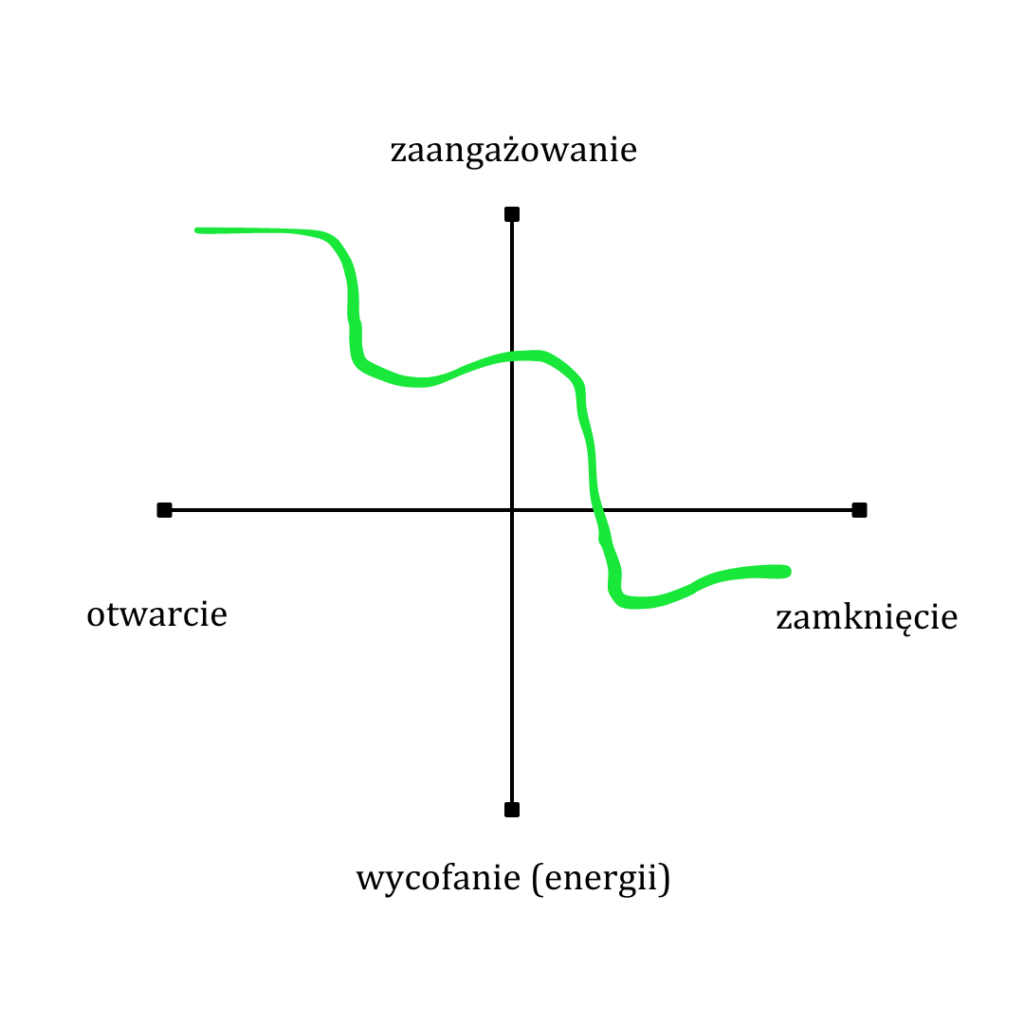
Our grace (or lack of it) in moving across the matrix described above is influenced by many factors. The safer we feel at a given moment, the stronger our sense of agency, and the more regulated and calm we are, the easier it is for us to respond flexibly and in a way that benefits us. But the more emotional turmoil, powerlessness, and aversion there is in us, the less psychological flexibility we have.
Trauma, however, is one of the circumstances that most powerfully cuts us off from our psychological grace and fluidity. The experience of trauma is a signal to the nervous system that (in the past) it failed to protect us from something important: that it opened up to something too much, reacted too slowly or too quickly, that it let go where action was needed or acted where it should have let go. And — for the sake of our survival — the nervous system never wants to let such a mistake happen again. In this situation it can be compared to a parent who didn’t notice their child spilling a splash of boiling water on themselves and, as a result, forbids the child to touch any hot liquids for years to come. The parent’s rigidity is excessive; it doesn’t let the child fully grow and acquire new skills, but from the point of view of a parent scared out of their wits, this is the only way the child can be saved from getting burned. It’s similar with our nervous system: if our trauma involved, say, a bicycle accident at night, then just to be on the safe side the nervous system may link the feeling of sheer terror with nighttime, but also (why not!) with darkness, with riding in vehicles, with speed and noise. In the face of trauma we react excessively, irrationally, and very rigidly — but, from the point of view of our survival, very effectively.
Trauma takes away our psychological scaffolding, offering in exchange either complete emotional and behavioral chaos or a non-negotiable rigidity in our feelings and reactions. Our nervous system then never lets up in its vigilance and activity, making us lurch abruptly between maximum arousal and sudden, non-negotiable exhaustion. The range of experiences we respond to with openness after trauma shrinks, too: we may avoid like the plague the feeling of defenselessness and weakness, but also the feeling of strength, energy, and agency (the nervous system does what it can to hold us back from anything that might lead us to a repeat of the trauma). At the same time we lose clarity about what serves us and what doesn’t, and we may fail to notice that something is affecting us in a destructive, toxic, draining way (after all, ignoring extreme pain may once have allowed us to survive). In other words: after trauma, our matrix of adaptation and flexibility becomes quite a muddle indeed.
So can the nervous system ever regain its grace after trauma — that is, respond appropriately to experiences from the here and now (and not from the traumatic past)? Yes — the answer to that question really is a big YES. It’s worth knowing a few important conditions of that “yes,” though, because on our path of healing we like to give in to dreams and illusions rather than to a realistic picture of our progress.
An important part of regaining flexibility after trauma is grieving that beautiful, effortless (and often idealized) state of not worrying about our mental state, which we associate with the time before the trauma. Returning to the state “before” is not only impossible by now (our nervous system has changed, after all, and so have we); it would also be inadvisable. The experience of trauma — however dramatic — needs to be woven into the fabric of life, not forcibly pushed out of it. The point is not to reset our psychological timeline to zero, but to open up to the present and the future, whatever our future may hold.
Nor does the way back to a flexible nervous system lead solely through reflection, analysis, and conversation (or not only through them). If our nervous system has been badly frightened by something, it’s not enough to try to convince it, from the level of our mind, that it is safe; appealing to our willpower or scaring it with consequences won’t do the job, either. The nervous system learns through experience, and the superficial layer of our thoughts or words doesn’t stand a chance against post-traumatic consequences recorded very deep in our nervous system.
We also need to identify precisely where the limits of our grace and flexibility of response lie. So first we have to see the points on our psychological matrix where we get abruptly or stubbornly stuck. Where does our nervous system rev itself up to a frenzy (e.g., reacting with flight at the mere thought that someone might give us an injection), and where does it dramatically run out of strength (e.g., not letting us leave the house for days on end after an injection)? Where do we close off inappropriately to some experience (e.g., we’d rather drink ourselves senseless than face the stress of a flight without our “painkillers”) or open up to it even though it doesn’t serve us at all (e.g., we stroll through the most dangerous neighborhood in our city at 5 in the morning)?
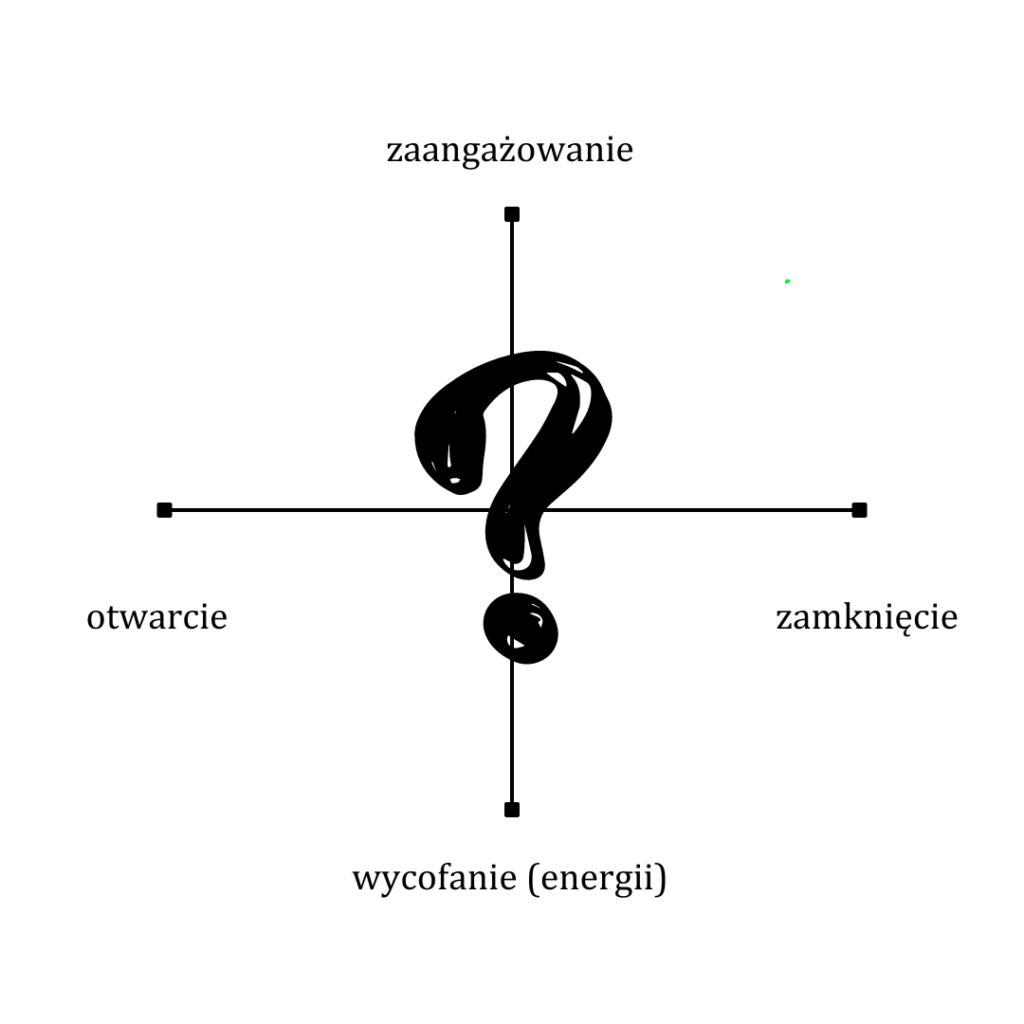
Let’s also remember, though, that self-awareness helps but does not have the power to heal in and of itself. On the basis of this newly gained awareness, we need to build, step by step, trust in ourselves and in life. To build it through experiences, and not only through instructions (orders?) issued to our nervous system. To build it through small steps, not through huge, unrealistic (at least in the here and now) goals. So if, for example, I’m afraid of crossing bridges (anyone who has been to my workshops knows this story well), I won’t expect myself to walk straight across the Dom Luís I Bridge in Porto (it’s 45 meters high! :)). I’ll rebuild my flexibility by first stepping onto the dock on the lake in my forest. Then by stepping onto a bridge that I’ll cross arm in arm with someone who wishes me well and who soothes me best in moments of tension, and only later (when I’m ready) will I walk across that bridge alone. And maybe only then will I decide that Porto is for me, too, and choose to cross that famous bridge. Or I’ll let that bridge go once and for all (psychological flexibility is not, after all, the same as doggedness; so it’s possible that, as I heal, I’ll also decide that crossing the Dom Luís I Bridge is something I have no need for in my life).
Remember that nearly every point of rigidity or chaos on your psychological matrix is a testament to your earlier suffering. So as you rebuild your psychological flexibility, go slowly, with love, with the option of choosing for yourself whether today you’ll be serving yourself discomfort or not (trauma took away our ability to choose, so healing means restoring the choice that was once taken from us). Have as much understanding for yourself on this path as you would for a puppy you wanted to get used to walking past bicycles without fear (a puppy that had once been knocked around by a bicycle). Talk to yourself the way you would talk to that puppy (with tenderness and attention, but also with firmness). Touch yourself (yes, literally, hug yourself) the same way you would touch that puppy as it trembles when a bicycle goes by. Don’t wear yourself out with training sessions that are too long (just as you would let the frightened little puppy run free between flexibility training sessions). Delight in everything that is beautiful in you alongside (not in spite of) the consequences of trauma (your puppy, alongside its fear of bicycles, is dazzling too, isn’t it?).
Have lots of love and patience for yourself and for your nervous system. I’m rooting for you with all my heart!
Sabina


