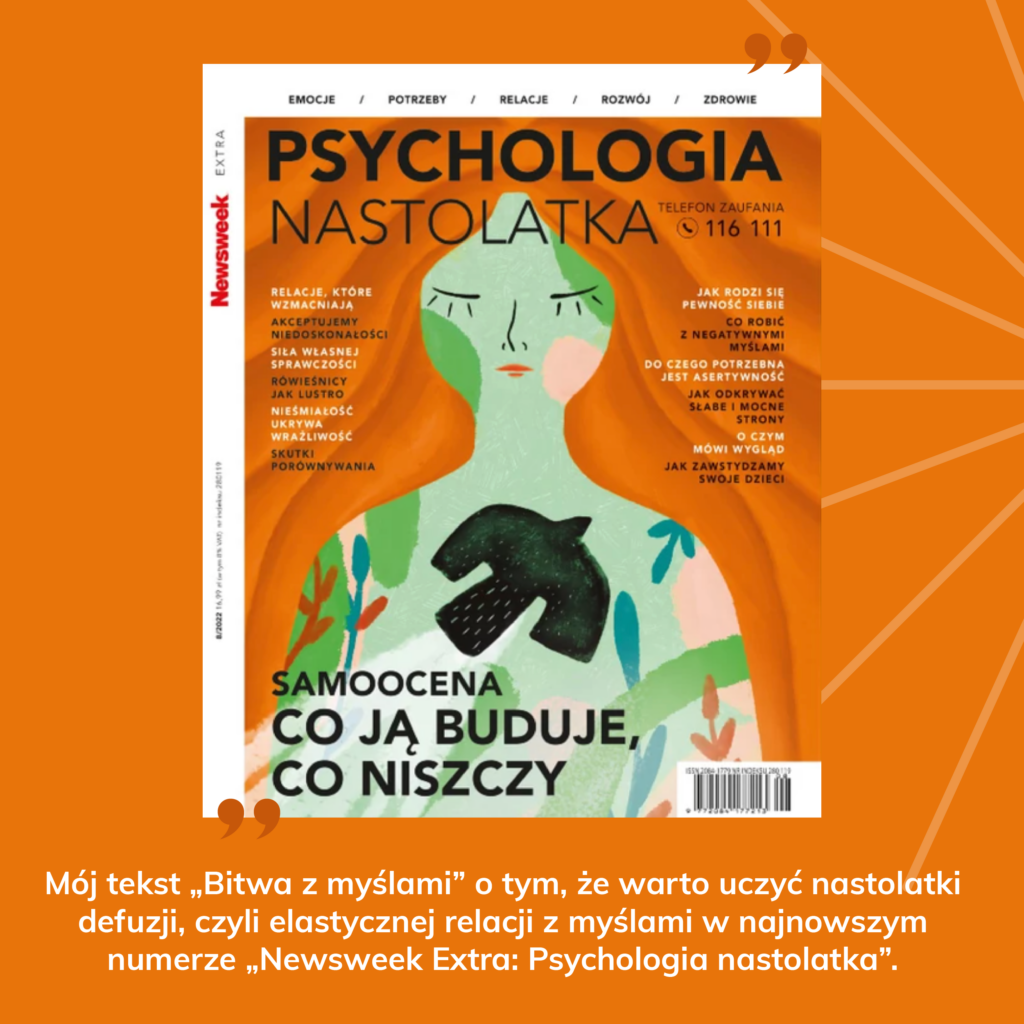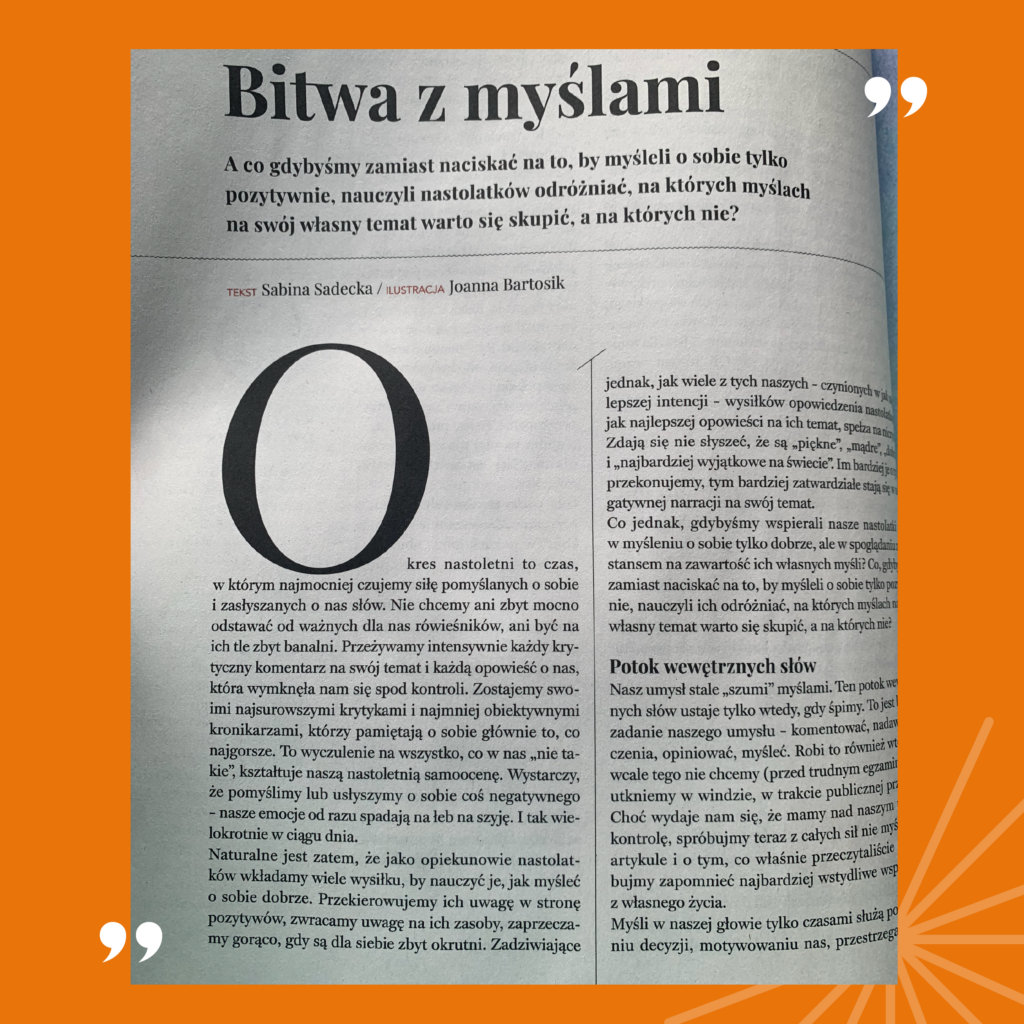



In the latest Newsweek Psychologia: Psychologia Nastolatka, you’ll find my piece “The Battle with Thoughts,” about how worthwhile it is to teach a teenager a flexible relationship with what’s inside their head.
An excerpt from the piece is below.
Enjoy the read!
“The distance that saves
It is extremely important to teach teenagers that they are not their thoughts. Just as the word “cat” is not an actual cat (but merely a cluster of sounds or letters), the thought “you’re hopeless” is not equivalent to any part of our psychological functioning. At most, it is a by-product of the activity of our ever-working mind, which ceaselessly comments on our inner and outer reality. We can treat the stream of thoughts flooding us like a radio show constantly playing in the background — after all, we don’t have to tear ourselves away from what we’re doing when we listen to the radio; it can just play in the background. It’s similar with our judgments about ourselves — we can let the mind say whatever it pleases about us and, at the same time, not let it pull us away from the things that matter most to us.
Even the very best thoughts about ourselves are always simplifications and do not capture our full complexity. This is especially important in the world of teenagers, who persistently look for labels that would let them classify themselves safely, and who suffer when they don’t find them. Thoughts are only thoughts, just as labels are merely labels. It’s worth talking with teenagers about the fact that no words will capture who they are, and no words will ever fully define them. Russ Harris, a psychotherapist and teacher of contextual therapies, once wrote that the label on a jar doesn’t change the contents of that jar. The same goes for our negative thoughts about ourselves.”
Sabina