


***
“Learning is not the accumulation of pieces of knowledge. It is growth, in which every act of knowledge develops the learner, making them capable of creating ever more complex objectivities — the growth in the complexity of the object corresponds to the growth in complexity of the subject.”
Husserl as interpreted by Quentin Lauer (in: R. May, “Love and Will,” trans. H. Datner-Śpiewak and P. Śpiewak)
“Education is not the filling of a pail, but the lighting of a fire.”
William Butler Yeats, (in: A. Norman, “The Resilient Mind,” trans. T. Bieroń )
“It is not experience but experiencing that is the source of learning.”
Alice Kolb and David Kolb, “The Experiential Educator,” trans. M. Bręgiel-Prat
***
We learn psychology slowly. And although we can learn theories, research findings, diagnostic typologies, protocols, and techniques very quickly, understanding a human being — all their many layers, their changeability, their diversity, their simultaneous strength and fragility — demands time, courage, and cognitive tenacity from us.
I don’t believe that knowledge presented in a few swipes of a finger on a short video can capture the complexity of our human existence. Or that a single short webinar or podcast episode could be enough to get comfortable with any topic in psychology and/or its application. Absorbing the bullet points is only the beginning of the scholarly adventure (or a new beginning, before everything gets tangled up again). Behind a single bullet point there are decades, sometimes hundreds of years of research, and perhaps even thousands of years of observation and analysis (ours is, after all, not the only era to have studied the human condition). So working in psychology with nothing but bullet points/protocols/recommendations/“advice” is, to me, either reductionism or/and nurturing the illusion that we can fit our inner diversity into the format of an Ikea instruction manual.
We need to look at the human being from many different perspectives. Our behavior is determined by our own biology and history, by depth and breadth, by interoception and exteroception, by the most complex thoughts as well as the simplest impulses. Psychology demands to be learned gradually (and not only linearly), along many threads at once, reaching into related fields, looking into the experiences of scientists but also of philosophers, studying our own biography (the by now famous “research is me-search” of Beatrice Beebe, the attachment researcher; Prof. Carolyn Ellis, in turn, calls such study — beautifully! — “autoethnography”) as well as the biographies of other people.
To understand the human being, we need to learn psychology by letting into our cognitive system not only words and facts, but also by observing and interpreting the feelings of delight or anger that arise in us, or the bodily sensations that signal that something in a given theory doesn’t sit right with us — or that, thanks to it, everything is suddenly clicking into place. We also learn it by applying knowledge to our work with people and watching what fits and what flatly refuses to confirm the assumptions of the theory or the guidelines drawn from research.
Studying psychology asks us to be active in that studying, inquisitive, both thinking against the current and sometimes allowing ourselves to step obediently inside the frame of a particular paradigm, school, or technique (so as to get to know it through and through, inside out). Studying is, after all, a verb, not a noun with a list of trophies in the form of our academic degrees, diplomas, licenses, and books read. There is no such thing as fast learning when it comes to understanding the human being. Bullet points (even the ones added to this text) are merely a record of a temporary simplification of an infinitely complex human reality.
***
Below I’ve gathered a few of my observations about what helps me keep a constantly fresh view of the field I work in. I believe, though, that not only psychologists (or psychologists-to-be) will find something for themselves in these reflections.
***
- Acquiring knowledge as a commitment that saves our well-being
Keeping an open mind and a scientific curiosity seems to me not only a privilege but also a professional obligation (an obligation, incidentally, that is codified in many professional codes for psychologists and psychotherapists and — though less often than you might think — systematized and enforced). And although the culture we live in is not fond of commitments (especially long-term ones), they are precisely what seems to be an important component of our sense of meaning in life and our well-being.
In a groundbreaking, research-packed book, “Brain Energy” by Chris Palmer (I wrote to you about it in my letter before last), which is mainly about the connection between mitochondrial health and mental health, I found a — completely non-mitochondrial! — “4R model.” It is a model describing the social and psychological factors that help us maintain our mental health. The first R is (of course!) close relationships, “remaining in close relationships that are good for us.” The second R is meaningful roles, that is, “fulfilling roles in life that are useful to the community we live in” (on this subject I especially recommend the book “Awakenings” by Oliver Sacks, lately my most beloved author, in which he describes how people with encephalitis lethargica recovered as long as they were able to play a useful role in the community of Mount Carmel hospital; when that condition was missing, they practically wasted away before one’s eyes). The third R is adherence to responsibilities and obligations, “honoring our commitments/tasks.” Being reliable in our commitments (sometimes also those we impose on ourselves — do you remember my letter about discipline?) means filling our life with a sense of meaning, agency, and competence, but also predictability and constancy. For many years now I have been continually amazed at how much of therapy sessions is taken up by procrastination, and how badly being stuck in the middle of a task drains our energy and our trust in ourselves. And the fourth R is adequate resources, resources adequate for fulfilling our roles and meeting our commitments.
[From my days as a psychology student I also remember well a study by Ellen Langer, in which she gave each of a group of nursing home residents a potted plant to take care of every day (a second group of seniors did not receive a plant). After 18 months of the study, it turned out that in the group of residents who looked after a plant, half as many seniors had died as in the control group. That sparked my curiosity about how engagement supports our health (and not only our mental health). I was able to study this further during the good few years I spent learning acceptance and commitment therapy.]
I believe each of us needs to be responsible for something — even something small. Acquiring knowledge is my almost daily commitment. There are, of course, periods of breaks from reading or training, of cognitive regeneration, of time without structure and without new cognitive challenges (perhaps you remember my piece for Newsweek Psychologia, “There is no growth without a break from growth”?), yet psychological questions keep arranging themselves in my head all the time (sometimes without my even noticing). Learning new things is my way of taking care of all four Rs in the model Palmer describes. For me, acquiring knowledge means conversations and connection, it means fulfilling my professional role, it means honoring my commitment, and it is a way of taking care of my resources (cognitive ones, but not only those). Acquiring knowledge allows me to give something to the world, but it also allows me to take from that world. Thanks to this commitment I can be rooted in my life, and also flow freely through it. Belong and have freedom. Engage in what matters and face what is inevitable.
2. Our brains don’t like learning by rote; our brains need to solve problems
For me, the most important moment in the learning process is the moment of asking myself questions. As a result, I have more questions in my head than answers I have ever given myself. I acquire knowledge not in order to know, but in order to unravel a riddle that sometimes walks around with me for decades. “What makes some people who smoke cigarettes live to a ripe old age in good health?”, “Why does one person respond to a psychological shock with numbness, and another with full contact with the shattering reality?”, “Do excitement and anxiety really activate the same area of the brain?”, “Can we have memories from life in the womb?” and so on, and so forth.
I’m not looking for quick answers. I’m looking for answers that will not only describe reality but also explain it (at least for a while). I also know that there are riddles I won’t have enough life to unravel (but that doesn’t stop me from trying!). I’m aware that a description does not always equal an understanding of a given question (and understanding does not always translate into being able to apply a given mechanism in practice). I don’t give up. I take notes systematically. I read further. I ask follow-up questions. I arrange my thoughts by writing (to you, too). I am in cognitive motion. As long as that motion is possible (even by a millimeter a day), it is also possible to nurture what my heart smiles at.
3. (Cognitive) life is most fertile in the “in-between” zones
I’m not interested in living by any dogma. I’m more curious about living toward what is important than toward what is (always and indisputably) right. To understand psychology, I need to go beyond any “always” and “never” and get to know a variety of paradigms of knowledge. In “Migraine,” which I have been reading lately, Oliver Sacks concludes that the phenomenon of migraine cannot be captured by describing it with only an anatomical-vascular explanation, only a biochemical one, or only psychoanalytic explanations. To understand migraine, a phenomenon characteristic only of humans (which seems very significant to me here!), we need to remain on the edges of these paradigms, get to know each of them, and allow ourselves to look at migraine from the perspective of what lies “in between” them.
Psychology is a discipline of the edges. We are utterly unique in the animal world and, at the same time, animal through and through. To study psychology, we therefore need to venture far beyond it, visiting the worlds of biology, chemistry, physics, and medicine, but also sociology, economics, ecology, political science, history, and philosophy.
Studying psychology in depth asks us to reconstruct (so as not to write “demolish”) the cognitive/substantive status quo every once in a while. Never taking off the lenses through which we have learned to look at the world puts us at risk of cognitive stagnation. In learning we need the “chaord” (Dee Hock’s term, a blend of the two words “chaos” + “order”), that is, both order and the disturbance of that order — chaos. From the combination of the two emerges a knowledge that is not merely labeling and listing; it is knowledge “in between.”
[One of my all-time favorite “in-between” areas has always been literature (especially nonfiction), which lets me broaden my understanding of the human being in ways I would not find in psychology textbooks. I love Steinbeck’s novels, so Jungian in what they say, all kinds of biographies and conversations showing human resilience (or human fragility) in extreme conditions (“Vera Gran: The Accused,” “Little War,” “Love Is Worth the Effort,” to name a few), contemporary novels about human nature (“Bitter, Bitter,” “The Woman in the Dunes,” “Silk,” and so on, and so on), as well as therapists’ stories about their work (Yalom’s books, “Emotional Inheritance,” “The Devil You Know”, and so on, and so forth).]
4. The harder, the better
Obstacles on the path to learning, unsolvable problems, stumbles, and doubts are the best things we could wish for in our learning. I love the concept of “desirable difficulties” developed by Robert Bjork, a researcher of adult learning. He showed that introducing difficulties into the learning process significantly improved long-term retention of the material.
Frustrations, mistakes, and a sense of temporary helplessness are therefore our allies in studying (so is even learning from notes written in hard-to-read handwriting — this has been confirmed by research :)). Right in the spot where you are currently stuck with the material lies a gateway to knowledge that may stay with you for life.
5. Let studying be as tangible as possible
The context in which particular theories came into being matters to me, not just their content.
I like to know the faces of the authors of the books I read [that is how I found out, for instance, that Vivian Rakoff, who studied transgenerational trauma in the second generation of Holocaust survivors, was a man (online he is still referred to with feminine grammatical forms)]. When the name of a hospital appears in a textbook, I want to see it as soon as possible. I’m interested in whether Freud had children (of course he did) and how he treated Jung (variously, which, by the way, strongly affected Jung’s mental state).
I also like to saturate my learning process as much as possible with colors, movement, and space. To learn by writing. To learn by drawing. And finally: to learn by talking about what I’m learning, and to learn by teaching others.
The mentors of my learning are important to me: tangible people. Virtual ones too, who haven’t the faintest idea I exist, and ones who are no longer alive (did I mention Oliver Sacks? :D).
I want to learn from people who represent different views of psychology. I like to listen to them, but above all to feel their energy, and to see in that exceptional person something thoroughly human as well (for me this human component is a bridge: between that person and me — and a bridge is also an “in-between” space).
For me, deep study is living study. And although I love libraries, I know that studying reaches far beyond their reading rooms and collections. We study by immersing ourselves in life.
6. Repetition!
I return again and again to books I have already read (I passionately underline the important passages in them so that later I don’t have to wade through entire books). I leaf again and again through notes from old psychotherapy courses and conferences. I go back to old notebooks. It’s not just about the content I forget; it’s about giving new meanings to old content and integrating it into a system of knowledge that has grown and deepened considerably over time (the content may not have changed, but I, its recipient, have; I’m curious how the new me will receive the old content).
I read several books on a topic that interests me (at the moment I’m reading a lot about the metabolic health of our brain, and with each successive book the hopeless question marks smooth out a little, but the certainties from the previous books soften a little too).
I ask different teachers/supervisors the same thing. I ask myself the same thing at different moments in my life. I reflect on the answers. And I create new questions (and so on without end).
I like to know alternative explanations for a single psychological phenomenon. I like to name it using concepts from different paradigms of psychology.
I keep on searching…
…
***
I caught myself realizing that I could go on writing this text to you forever. But this is enough. With this text I wanted to restore due weight to the slow, gradual, uncompromising study of a field that matters to us. To learning that serves us/the people around us and our sense of meaning, and not only commercial goals. I hope I have succeeded at least a little.
In the meantime, I wish you a life of great intellectual stature! And since, for me, knowledge used in the service of others equals love, I also wish you a life full of love!
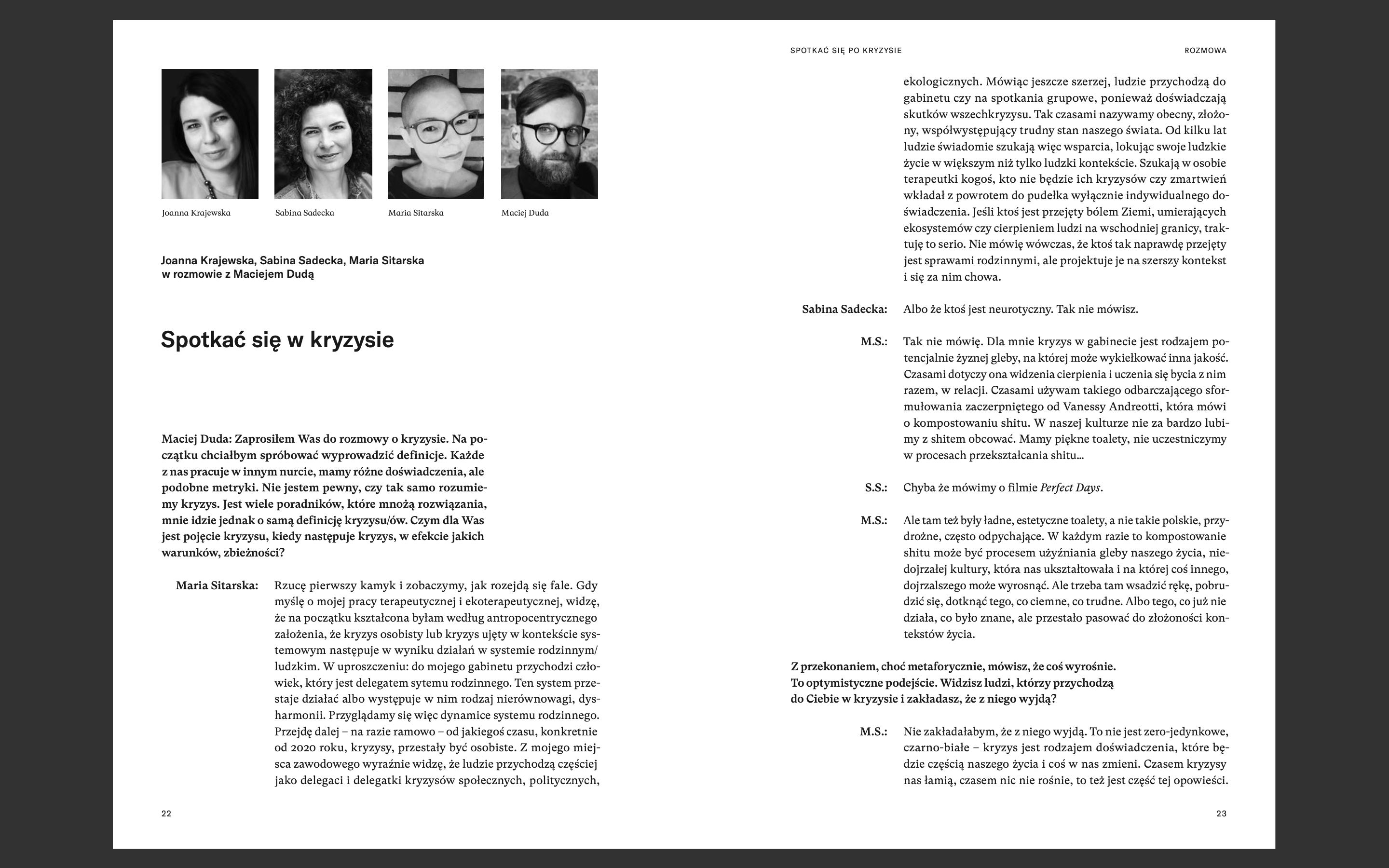
Sabina Sadecka
PS. I also invite you to read my piece on how not to waste the first years after a psychology degree and the one on how to become a psychotherapist. And one more on incorrectness in the psychotherapy profession.