

You cannot become ready to be a Somatic Experiencing practitioner by willpower alone. That readiness is earned with heart and mind, and through gentle, gradual, persistent training (with attentive trainers at your side). Slowly, step by step, at our own pace, we learn to put together the scattered puzzle pieces of this method (or perhaps rather this philosophy of thinking about the human being) and to make, out of those small pieces, a picture of transformation and healing.
For me, Somatic Experiencing is most of all about being fully present, about starting with yourself (before we begin working with anyone else in therapy ), about the pain and joy of contact with another human being, about freedom set within a substantive framework that makes such enormous professional and existential sense to me.
Somatic Experiencing is also about the fact that trauma does not define our lives, and that the memory of trauma in the body points us, as precisely as can be, to the ways of healing and integrating it.
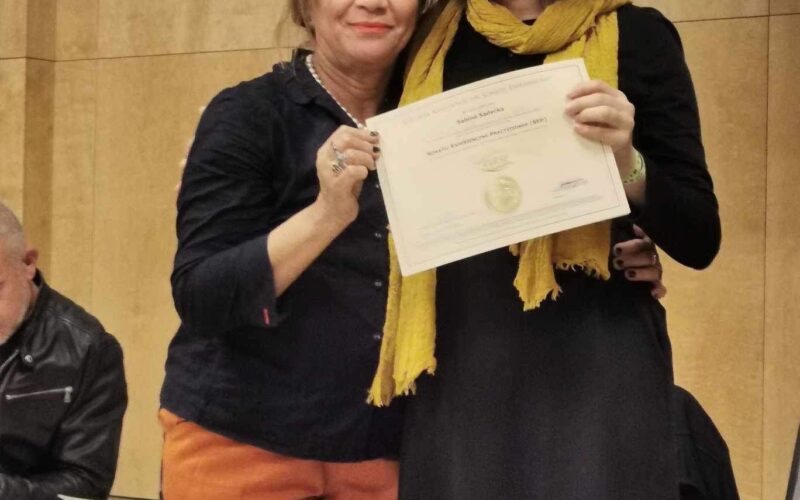
I like you, Somatic. I like you, Somatic community (tomorrow I’m signing up for the association :)). Thank you from the bottom of my heart for this 3-year adventure (and the thing about adventures is that sometimes you doubt, and at the same time, thanks to other people, you find the strength to get through the adventure’s turbulence; thank you, too, for the time of getting lost and finding myself again).
As of today I can call myself a Somatic Experiencing practitioner (I didn’t even know how much I had been dreaming of that title  ). I also know that this is not the end of the road. Somatic needs foundations. It needs to be supported by other methods, too. But it is a beautiful bridge to a person who cannot find the words to describe their trauma.
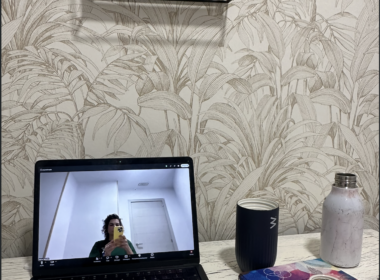
PS As usual, I have a few notes from the last — wonderful! — module of the course, with Sonia Gomes.
- in a state of coherence the organism regulates itself (trauma, however, blocks our access to coherence);
- a sense of safety is a balance between the sympathetic and the parasympathetic nervous system;
- with touch in Somatic Experiencing we are not fixing anything; we want it to give the client access to their own self-regulation;
- touch also allows us to reach a state of deep shock remembered by the body (the mind may not remember the source of that shock);
- titration serves to bring the client’s awareness down to a level at which they will be able to notice the signals of self-regulation and dysregulation coming from the body;
- contact with gravity allows us to calm the autonomic nervous system; working with the diaphragms allows us to activate inner touch;
- blocked joints store our trauma; in the eyes we can see the client’s pattern of physiological disorganization;
- and one more important question to end with: “how do I hold my level of defenselessness?”