

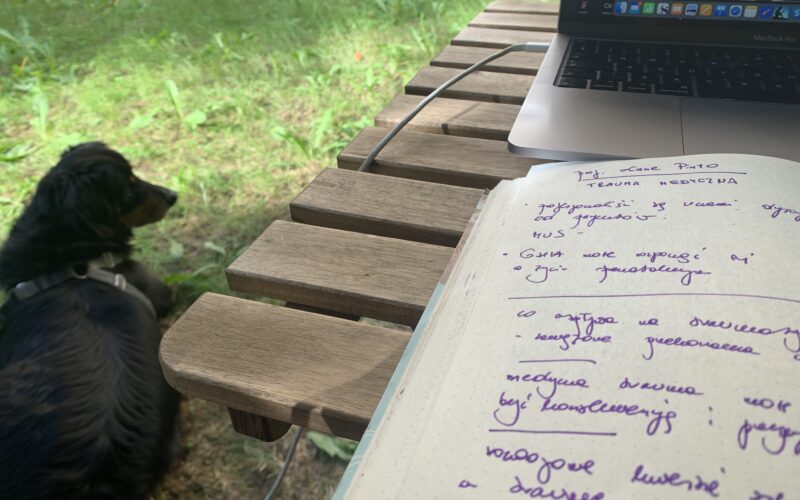
A few important notes from a workshop on medical trauma with Liane Pinto, which soothed my therapist’s heart and gave my head many new ideas for my work:
– Narrow beliefs about one’s own body can contribute to medical traumatization.
– Receiving a difficult medical diagnosis can also be traumatic when “we don’t have the energetic space for it at that moment.”
– Medical traumatization can be both a consequence of trauma and the cause of (another) trauma.
– Hypnotics (drugs that induce sleep before surgery) can block the explicit memory of an operation (“I don’t remember the surgery”), but the implicit, somatic memory of the procedure is not blocked (“my body remembers the surgery”).
– Medical trauma is not separate from other traumas, and traumas of other kinds may keep emerging in the therapy room as well — especially developmental and sexual traumas. Medical trauma often opens the “Pandora’s box” of earlier traumas.
– Trauma slows wound healing and recovery on the physical level.
– After a procedure, we may have difficulty orienting ourselves in time and space.
– A burn can leave us permanently hypersensitive to pain at the site of the burn or throughout the body.
– A significant indicator of the trauma of a bodily injury can be the client scratching themselves during a session (the therapist can titrate the scratching impulse).
– It’s important to observe where in the body (and in the client’s behavior) coherence is missing.
– In therapy for medical trauma, it’s important to keep returning to a state of social engagement.
– Symptoms are often stuck together; it’s important to choose, together with the client, the (single) symptom we’ll start with.
– During a session, let’s observe which elements of SIBAM (SIBAM = Sensations, Impressions, Behaviors, Affects, Meanings) emerge as the client enters the trauma vortex, and which as they enter the healing vortex.
– During a session, we let the client’s organism settle after even the smallest change.
Sabina Sadecka
***
If the topic of medical trauma interests you, I invite you to this webinar series.